KNIFE-017 – v16FULL: one off-the-shelf board instead of the breadboard
Problematic breadboard and PCB design - Not ready nor used, proper dedicated breadboard KNIFEs are KNIFE-018 and onwards.
📅 2026-10-16 · stav: hotové · priorita: vysoká · ✍️ Ondrej Špánik
The question: does any Arduino or Raspberry Pi on the market cover everything, or nearly everything, the v15FULL breadboard holds? Can it wake fast enough that the first whistle is recognised almost right after the button press?
Short answer:
- No single board covers it all. None that fits the bird combines the microcontroller, a LiPo charger, a microphone and a speaker amplifier.
- Raspberry Pi is out: its Linux boot takes seconds, and it draws far too much while idle.
- The closest fit is a Seeed Studio XIAO ESP32-S3: the same chip as v15, with the charger, the
regulator and USB-C on a 21 x 17.8 mm board.
- Two small I2S modules do the sound: a MAX98357A amplifier and an INMP441 microphone.
- v16FULL is v15FULL built that way. It replaces ten parts and modules (the DFPlayer Pro and the TP4056 among them), wakes from deep sleep in about 0.1-0.2 s, and starts the churr within milliseconds of the whistle.
The boards compared
| Board | What it covers of v15FULL | Start-up from a press | Between presses | Verdict |
|---|---|---|---|---|
| Raspberry Pi Zero 2 W | CPU only; needs a microphone, an amplifier, a charger and a power HAT | Linux: about 3.5 s on a fully optimised build (kittenlabs), tens of seconds stock (Volumio forum) | stays on: about 0.1 A, a 500 mAh cell lasts hours | no |
| Raspberry Pi Pico 2 W | MCU only; still needs a charger, a microphone and an amplifier | milliseconds | sleep possible | possible, but more modules than v16FULL |
| Arduino Nano ESP32 | the same ESP32-S3; no charger, no microphone | like the XIAO | like the XIAO | the TP4056 would come back |
| Arduino Nicla Voice | microphone, NDP120 always-on neural chip and a LiPo charger (BQ25120) | none: it listens all the time at very low power | always listening | the only true "zero-delay" option, but no speaker amplifier, about EUR 80-87 (Arduino store), and it runs its own model format, not the matrix |
| Seeed XIAO ESP32-S3 Sense | XIAO + camera board with a PDM microphone and microSD | like the XIAO | 3 mA quoted with the camera, about 64 µA without (Seeed wiki, ThePiHut) | the microphone sits on the camera board in the body, far from the sound port |
| LaskaKit ESP32-S3-DEVKit (Czech) | ESP32-S3, LiPo charger, 12 µA deep sleep, GPIO47 switches its second 3.3 V rail | like the XIAO | about 12 µA | second choice: 65.5 x 25.5 mm and out of stock on 2026-10-16 (LaskaKit) |
| Seeed XIAO ESP32-S3 + MAX98357A + INMP441 | everything: ESP32-S3, charger, regulator, USB-C, amplifier, microphone | wake from deep sleep, about 0.1-0.2 s to listening (below) | about 18 µA (simulated) | chosen for v16FULL |
v16FULL
| v15FULL | v16FULL |
|---|---|
| ESP32-S3 dev board, TP4056 module, D1 / Q2 / R8, XC6220 module | XIAO ESP32-S3 (U1): ESP32-S3R8, charger (about 100 mA), 3.3 V regulator (700 mA), USB-C |
| DFPlayer Pro, Q1, R5 | MAX98357A I2S amplifier (U2): the churr comes from the ESP32-S3's own flash |
| MAX9814 (analog, AGC) | INMP441 I2S microphone (J3): digital, powered from D2 |
| SW1, F1, C1, R1 ∥ R2, LS1, the cell | the same, plus R3 10k and five M2 mounting holes (H1-H5) |
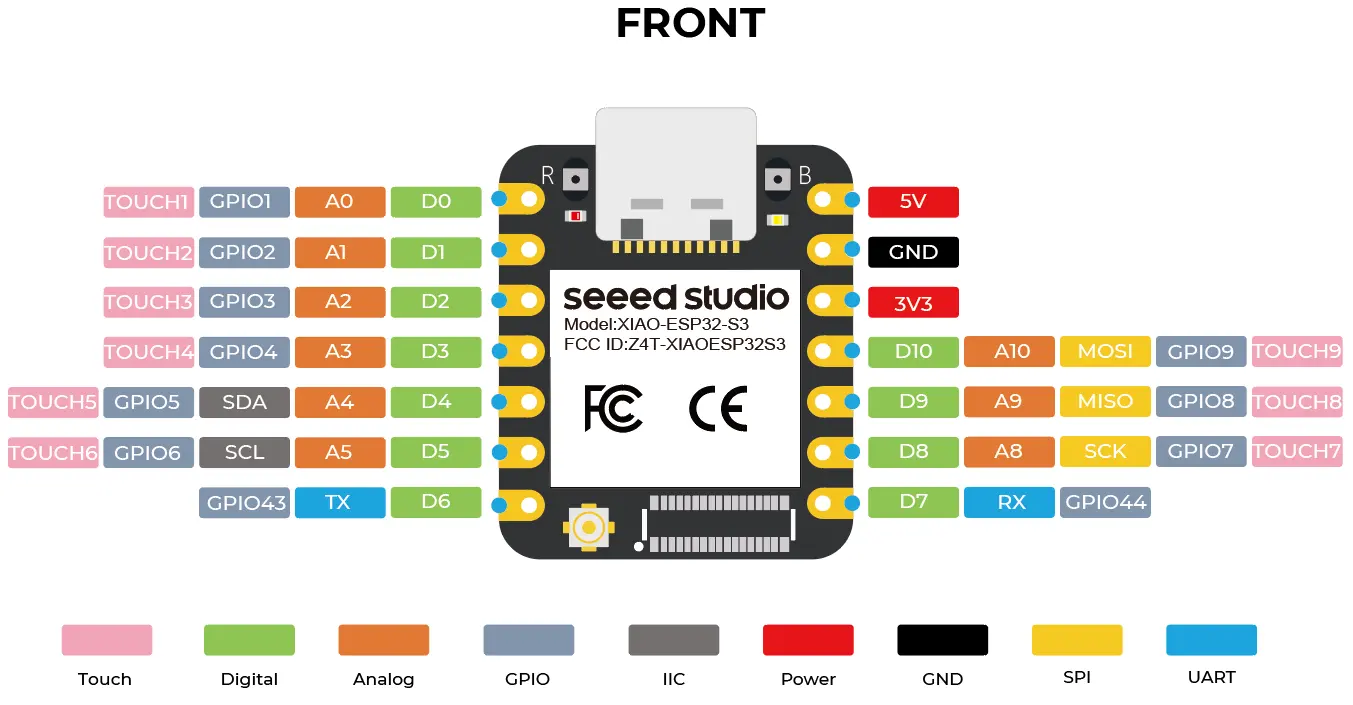
XIAO ESP32-S3 pinout (front; D1 = GPIO2 is BTN, D2 = GPIO3 powers the microphone; source: Seeed Studio wiki)
How it works:
- The cell stays on the XIAO's BAT pads (through F1) and charges whenever a USB-C cable is in.
- Between presses the ESP32-S3 is in deep sleep, the amplifier is shut down and the microphone is unpowered.
- The button connects 3V3 to BTN, which:
- wakes the ESP32-S3 (D1 = GPIO2);
- switches the amplifier on (SD_MODE over 1.4 V).
- Releasing the button lets R3 pull SD_MODE low. The amplifier shuts down at once, so "no sound without the button" is still guaranteed by hardware.
- The microphone's spectrogram is compared against the matrix (the trained CNN). The firmware is
written by hand by a colleague; the pins it needs are in
docs/v16FULL_parts.md.
Press to first whistle, estimated:
| Step | v15FULL | v16FULL |
|---|---|---|
| ESP32-S3 running | cold boot after the button connects power | deep-sleep wake: about 40-100 ms with PSRAM (or at least its memory test) off, about 480 ms with PSRAM on by default (ESP32 forum, Espressif) |
| Microphone ready | MAX9814, 200 ms assumed | INMP441: 85 ms from power-on at a 3.072 MHz clock, or 5-16 ms from standby if MICPWR is held on through deep sleep (ADMP441 datasheet figures, standby current to measure) |
| Listening | about 0.5 s | about 0.1-0.2 s |
| Churr after the whistle is recognised | DFPlayer Pro boot, about 1 s | a few ms (I2S from flash) |
So a whistle that starts together with the press is recognised as soon as the matrix's window is full: about 0.25 s of whistle for the reference detector. Only an always-on listener like the Nicla Voice could do better, and it has no speaker output.
Checks:
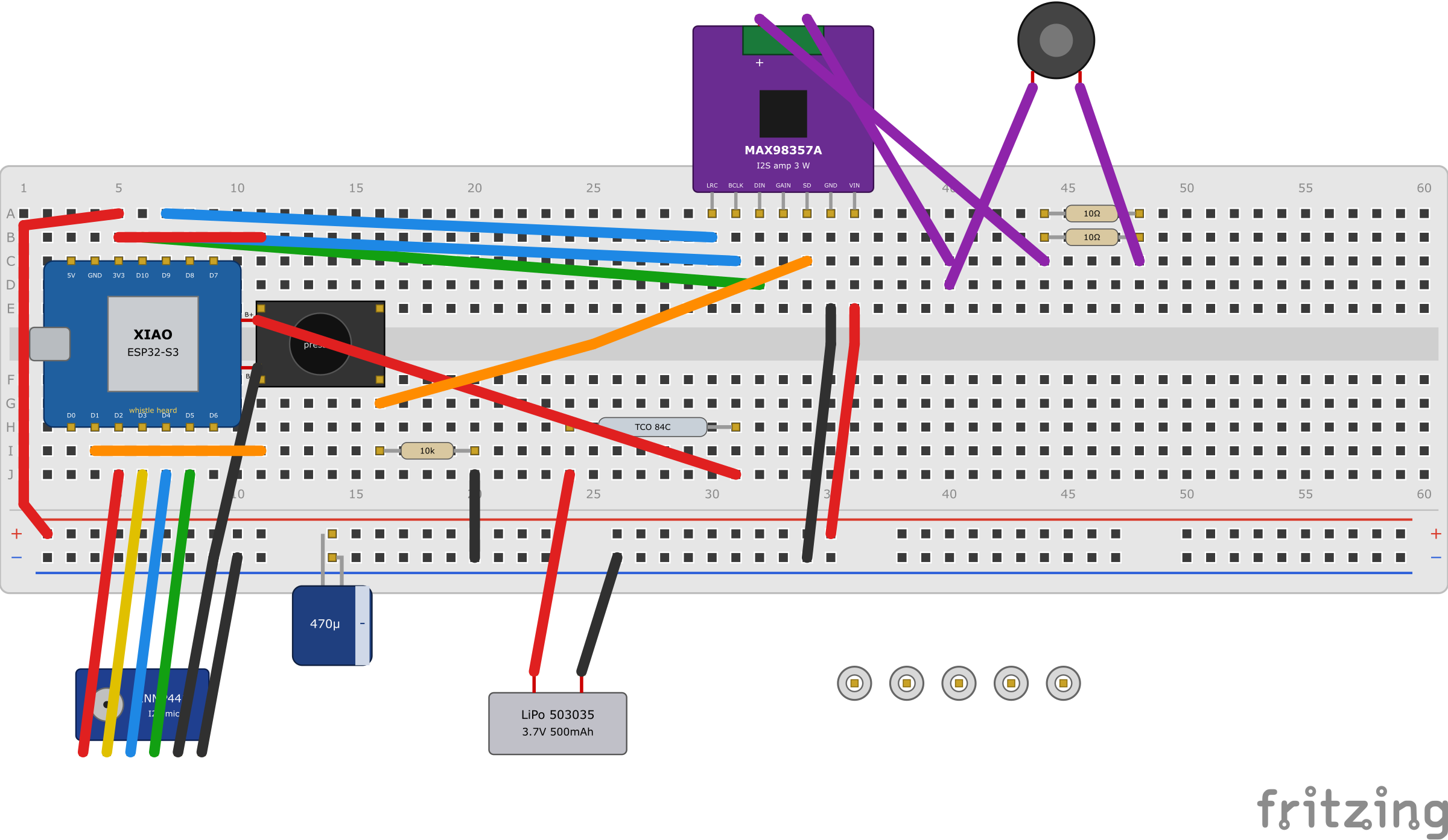
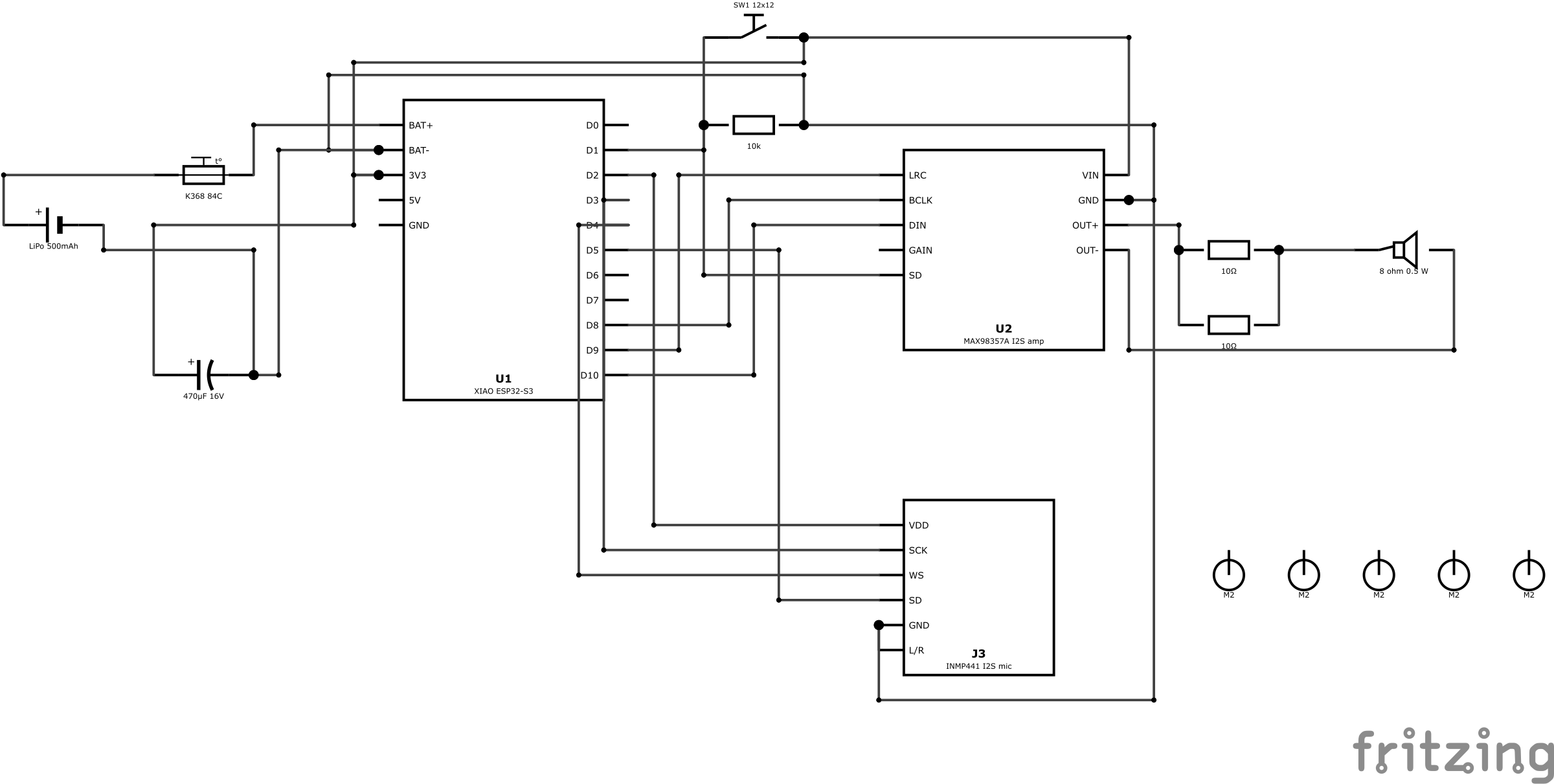
- breadboard nets = schematic (15 nets);
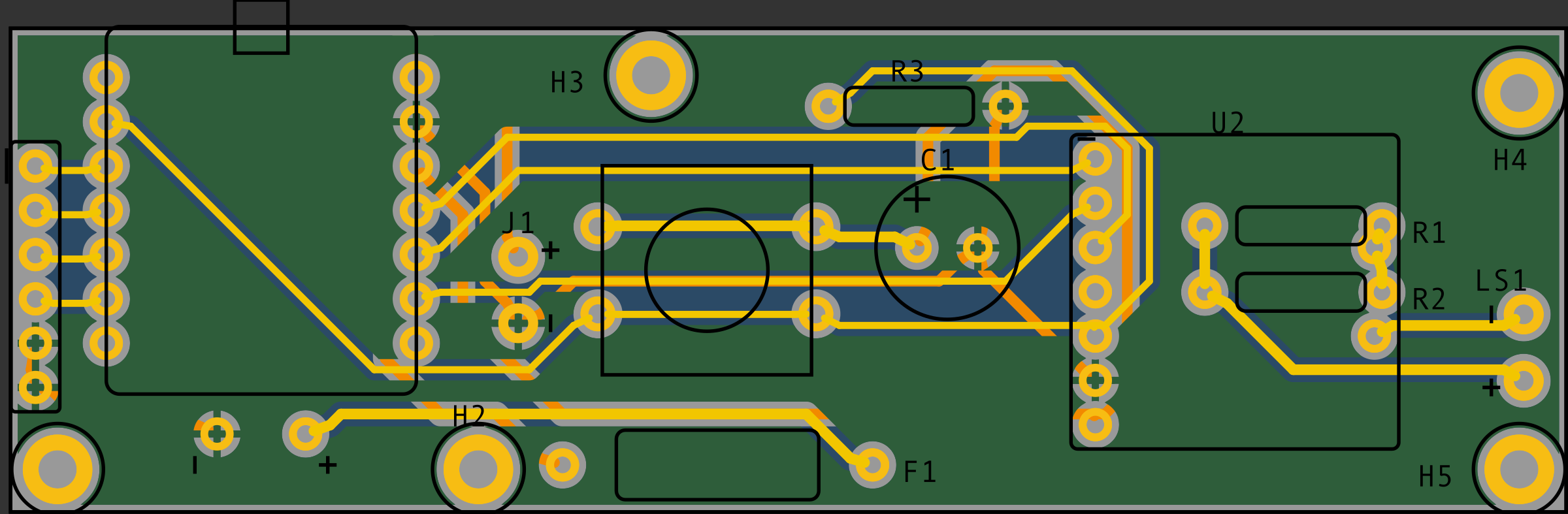
- PCB 15 / 15 nets, minimum gap 14.5 mil, 20 mil to the edge;
- same 89.4 x 27.9 mm outline, SW1 in the same place;
- no Gerbers yet.
Simulation (ngspice):
| State | 3V3 | BTN | MICPWR | from the cell |
|---|---|---|---|---|
| held, playing | 3.30 V | 3.30 V | 0 V | 0.233 A |
| held, listening | 3.30 V | 3.30 V | 3.27 V | 0.103 A |
| released | 3.30 V | 0.03 V | 0 V | 18 µA (about 3 years on 500 mAh) |
v16FULL breadboard
v16FULL schematic
v16FULL PCB (Fritzing's own view, then both copper layers from pcbcheck.py)

PCB layout and mounting:
- The XIAO sits at the tail end on 7-pin headers, turned so its USB-C port points out of the board's top edge, i.e. towards the bird's left flank.
- The microphone pads run down the tail edge, level with the XIAO's D2-D6, so their traces are straight.
- Five M2 holes (H1-H5, 2.2 mm) hold the board in the bird. Their positions avoid the speaker and cell pockets, and not every hole needs a screw.
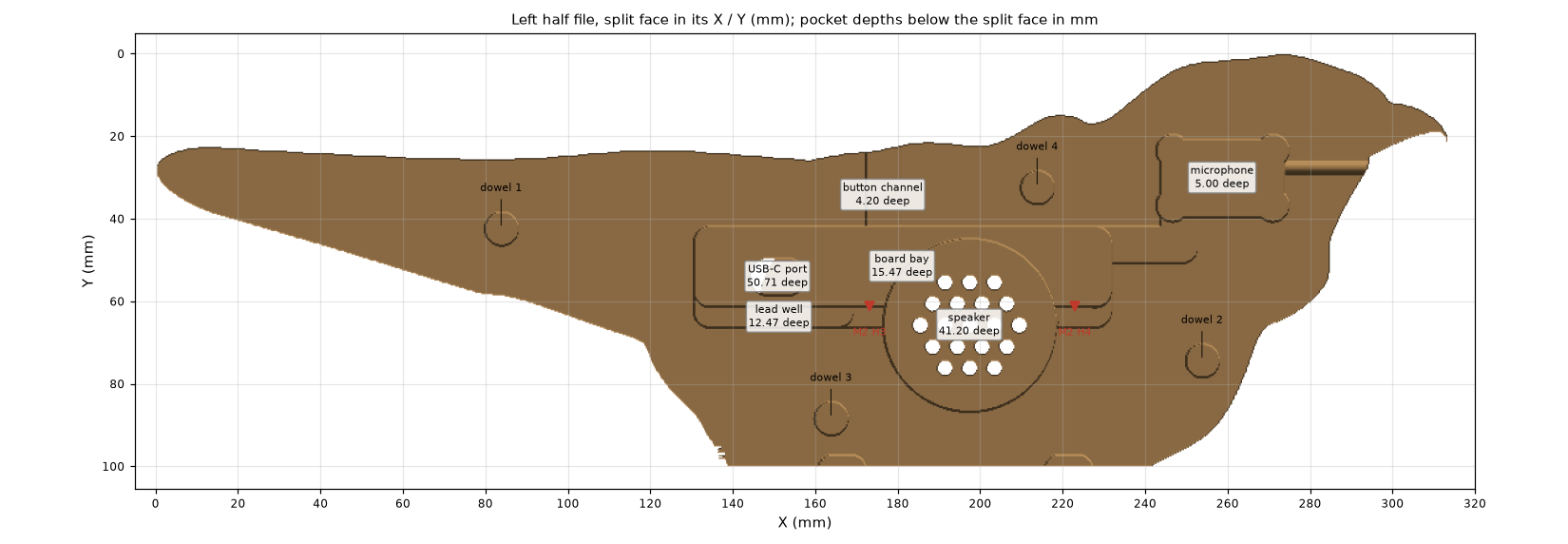
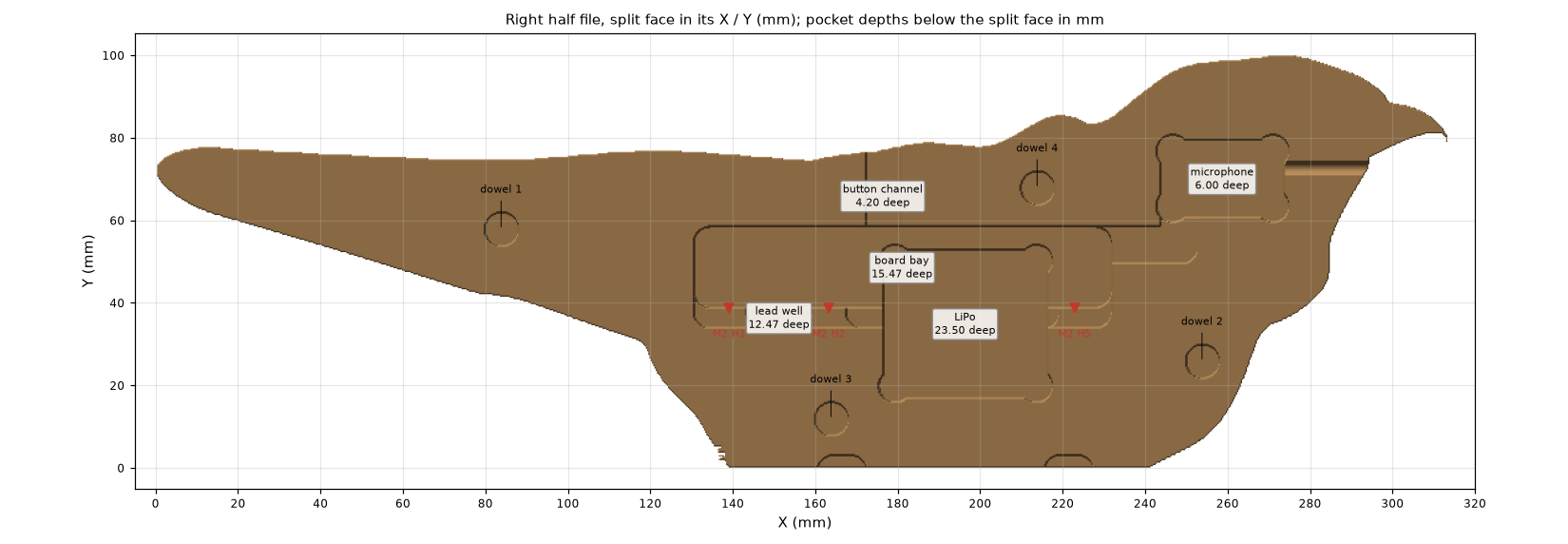
The enclosure for v16FULL
Nightjar v2 is rebuilt for this board: new STL files, pictures and guide in enclosure/ (the guide's PDF
too), and the 3D model on the websites.
| What | v15 enclosure | v16 enclosure |
|---|---|---|
| Board bay | 0.4 mm at the board edges, 15 mm above, 3.5 mm leads below, 4.5 mm past each end | 1.5 mm at the edges, 18 mm above, 5 mm below, 6 mm past each end |
| Board fixing | lying on 1.9 mm ledges | 1.5 mm ledges plus wooden screw ledges under H1-H5 in the lead well; M2 x 6 screws, 1.5 mm pilots drilled by hand through the board |
| Charging | micro-USB channel under the tail, to the TP4056 | USB-C port straight through the left flank to the XIAO (13 x 9 mm) |
| Cell pocket | 38 x 33 mm | 40 x 36 mm (air at both ends, top and bottom) |
| Speaker pocket | Ø40.6 | Ø42 |
| Microphone pocket | 28 x 17 mm (MAX9814) | 30 x 19 mm (INMP441) |
| Gone | ESP32-S3 bay, charger, Q2, U3 and their wire slots |
Air between each part and the wood (measured on the model):
| Part | Air (mm) |
|---|---|
| XIAO | 1.5 |
| its USB-C, in the port | 1.7 |
| amplifier | 5.3 |
| C1 | 5.5 |
| button switch | 3.1 |
| fuse | 1.6 |
| cell | 1.0 (foam tape side), 2.5 at the ends |
| microphone | 2.5 |
| board, speaker | rest on the wood (ledges, glued rim) |
Every pocket wall is at least 6.8 mm (the speaker grille; the dowel holes keep 5.2 mm or more), and no part overlaps the wood. The guide lists the pockets, screws and assembly order. One thing to check: the USB-C plug has to reach about 24 mm into the wood, so use a slim plug at least 25 mm long or a short slim extension.
What to order (2026-10-16)
| Shop | Ref | Part | Price | Stock |
|---|---|---|---|---|
| Seeed Studio (EU warehouse) | U1 | XIAO ESP32-S3 (113991114) | USD 7.49 + shipping | in stock |
| techfun.sk | U2 | I2S module MAX98357 3 W | EUR 4.95 | 31 pcs |
| LaskaKit | J3 | INMP441 I2S microphone (LA131146) | CZK 98 | 162 pcs |
| techfun.sk | R3 | Resistor 1/4 W, pick 10K | EUR 0.25 | in stock |
About EUR 16 plus shipping.
- The XIAO: neither techfun.sk nor LaskaKit stocks it, and Botland sells it only to businesses.
- From earlier orders: everything else (the cell, speaker, button, C1, F1, R1 / R2, headers).
- Not needed any more: the DFPlayer Pro, TP4056, XC6220, MAX9814, ESP32-S3 dev board, both MOSFETs and the diode. They still build v15FULL.
Things to know
- Charging: about 100 mA from the XIAO, so 500 mAh takes 5-6 h, cooler than v15's 0.36 A.
- Seeed doesn't document whether the XIAO separates its load from the cell while charging.
- Asleep it draws about 18 µA, far below the end-of-charge current, so the charge still ends properly.
- Battery protection: the TP4056 module's DW01A is gone. Over-discharge protection is now the cell's own PCB only, and the XIAO can't read the cell's voltage without an added divider.
- The amplifier runs from 3.3 V: about 0.26 W worst case in the 0.5 W speaker, through R1 ∥ R2.
- Some amplifier modules pull SD up; R3 wins against that.
- Measure SD with the button up: it must be under 0.16 V.
- The ESP32-S3 sleeps instead of being unpowered: releasing the button cuts the sound in hardware, but going back to sleep is the firmware's job.
- The enclosure (Nightjar v2,
NIGHTJAR_VARIANT=v16, the default now) is in the section below. - Details:
docs/v16FULL_parts.mdin ST-017-MOTHERBOARD;LELEK_board_v16FULL.fzz;.fzzbuild/build_v16FULL.py,variant_v16FULL.py,simcheck_v16FULL.py.